

Words & images by Sam Boothroyd | @sam_boothroyd
On the Hunt
It was mid-afternoon, and the full strength of the sun beat down on the backs of our necks as we hopefully scanned the bush edges and the expanse of boulders and tussock. Despite its promise, the basin remained stubbornly empty. Still, we refused to be deterred. Following a brief discussion, we settled in to wait. Our hope was that the fading light and cooling air would entice a deer to finally step out from the cover of the beech forest.
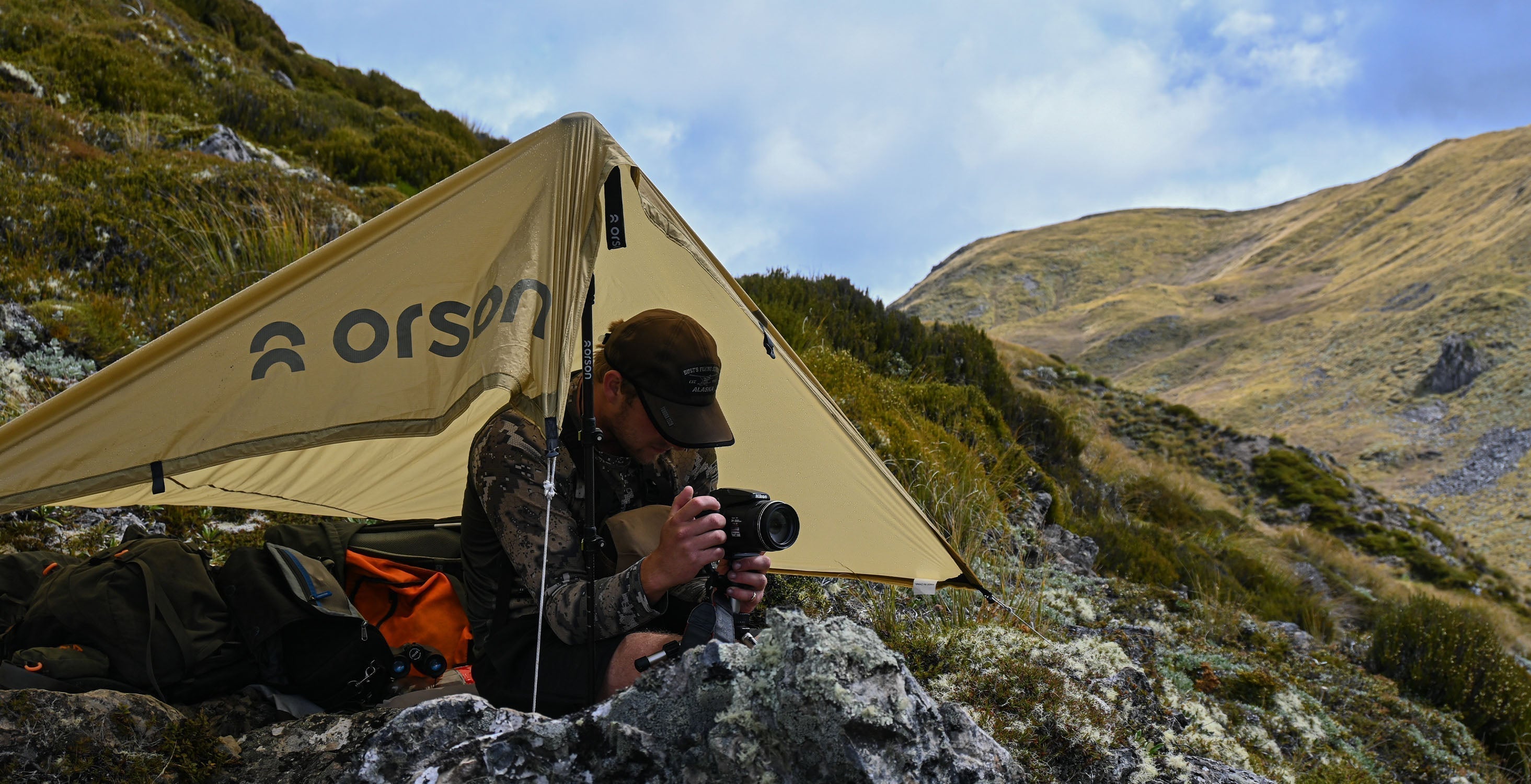
Since we had no plans to move, I decided to set up the fly, if for nothing else, to protect us from the glaring sun. It didn’t take long, and we quickly had the fly above our heads; it's incredible how such a thin piece of material can make a rough hollow on a mountainside instantly feel more homely and comfortable.
No sooner had we pitched the fly to escape the heat than the sky turned on us. The sun vanished behind a sudden ceiling of dark, heavy clouds that wasted no time opening up. As a cold wind began to ripple through the tussocks, the landscape transformed. In the space of a single hour, our lazy afternoon dissolved into zero visibility and driving rain, a stark reminder of how quickly the NZ backcountry can change its mind.
Normally, these conditions may have seen us take a hasty retreat back to the comfort and shelter of our tent, but in this instance, thanks to the protection of our fly, we could comfortably wait out the weather. As the clouds encompassed us and visibility dropped to near nothing, the act of glassing had become a distant memory, and I quickly fell asleep to pass the time.
Several hours later, I awoke to clear views of the basin below us; I sleepily began to pick apart the country in front of us, and sure enough, I picked up movement. Below us in the gut, I could just make out the orange back of a young stag feeding his way across a slip. We quickly organised ourselves and snuck down the scrubby ridge in the cover of some passing cloud cover and found a suitable shooting position well within range. The fog cleared, and I found the stag through the scope and squeezed the trigger.
I am certain I would never have had this opportunity on this stag if I didn’t have the fly with me; the fast-paced deterioration of the weather across the afternoon would normally have had us hastily scurrying back to the safety of the tent. Thanks to the shelter of the fly, we had sat out the weather and got lucky on a deer.
This highlights the importance of persevering through the weather. As visitors in the mountains, bad weather is often optional; we can push through it, or we can retire to the warmth and dry comforts of shelter. For the animals that live there, bad weather is the norm. To be a successful hunter, sometimes you have to persevere even in difficult conditions. Any tool that helps us stay out there longer is a valuable weapon in our arsenal.


Tarps Around Camp
Not only can tarps make amazing shelters for a variety of different uses, but they can also be a great addition to your campsite alongside your tent. The ability to extend the dry and sheltered footprint of your camp can be a game-changer in rough weather or if you're gonna be set up for a while. Considering a tarp's compact size and lightweight nature, they are an obvious choice for that little bit of extra shelter.

I was recently on a 5-day hunting trip down south; we planned to camp for 4 nights up some massive and remote valley systems in search of deer and chamois. Before heading out on the trip, the forecast was looking pretty good, aside from one day of full-on rain. The idea of sitting in a tent for the whole day during a rainstorm wasn’t particularly exciting, so we opted to bring the 3 x 3 metre skyline tarp to give us a bit of breathing room whilst we waited out the storm.
With its lightweight nature, it didn’t add much to our heavy packs, and we basically forgot about it for the first few days. It wasn’t until we heard reports of the rain coming that we remembered we even had it in the bag. The forecast was for forty millimetres of rain overnight, a fairly heavy amount of rain to wait out in a tent.
With the anticipation of a heavy night of rain, we realised the need to bunker down and started searching for an appropriate campsite. We eventually found the perfect spot, a beautiful flat site amongst the beech trees, with an overhanging rock cliff nearby to light a fire. After setting up our tents, we finally dug out the tarp and put it to use. We stretched it in an A-frame style so that it covered both tents and provided a dry spot between them for our gear and cooking, if need be.
In this case, not only did having a tarp make our camp bombproof, but it also provided that much-needed peace of mind that we were protected from the coming weather. That night, we all slept through the rain and awoke to dry tents and dry gear.


The first night, we used the tarps as wind breaks to protect our tent, which made for a reasonable sleep, considering trees were coming down not too far away. The rest of the trip, the tarps kept our firepit dry, collected snow for drinking water and protected us from some cold rains. This was a great example of how a simple piece of waterproof fabric can make a camp go from a place you sleep to a home in the hills.
Tarps for Glassing
As I mentioned at the beginning of this article, tarps can be an excellent piece of kit when you're sitting out in the elements, glassing for hours on end for animals. They can keep the sun off you on those scorching hot days in the tops, and equally they can keep you dry when the clag and drizzle rolls in, or when the rain and wind pick up and set in for the long haul.


When you spend entire days sitting on ridgelines watching nature go about its day, even a small amount of shelter can massively improve comfort and keep you out there longer.
Emergency Shelters
Tarps are also an extremely valuable piece of kit for emergencies and survival situations. I will often carry my 2 x 3 metre skyline tarp on trips that I don’t plan on camping. It doesn’t take up too much room or add much weight, and you really never know when you might need it.
There is always the possibility of getting caught out in the hills; it could be something as small as a trip or a fall, or simply a shift in the weather. But having the ability to set up a dry shelter in any scenario is invaluable if things don’t go to plan.
Tarps for Camping
Tarps aren't just a secondary shelter, though; they can make an awesome primary shelter, especially when the weathers more favourable. Swapping out the fly for the tent can really help cut down on weight and bulk if you want to travel light.
On top of reducing pack weight, it can make for some epic camping; there's something pretty special about open-air camping, and it really adds an element of excitement to the night to see the stars as they pass overhead and to listen to the noises of the night with nothing but air between you.


I remember first being introduced to fly camping, back in outdoor education at high school. We were never allowed to use tents and would always sleep under a fly. That feeling of sleeping out in nature has stuck with me ever since, and it really makes you feel alive and connected to the country around you.
Recently, a group of 5 of us went for a mission up a classic Canterbury valley and with the weather forecast looking perfect, we decided to take the brand new 3 x 3 metre Skyline Tarp for an outing. After a long day slogging it up the valley and a few hours bashing our way up a side creek, we were fairly knackered and desperate to set up camp and rest our legs; we pounced on the first flat spot we came across like a hawk on a rabbit and within the space of five minutes, we had shelter for five of us set up for the night.
The simplicity is one of the biggest advantages of tarp camping: quick shelter, minimal weight and the ability to camp anywhere.
On another trip, the tarp really came into its own; I was taking my parents out for their first hunt. The plan was to do an overnighter into Lewis Pass pre-roar to try and find a deer to knock over in order to fill our freezers. I planned to travel light, as the route was going to be steep, and I wanted a light pack to fill with venison for the walk out.
To make things easy, I took the 3 x 3 tarp for shelter and the 2 x 3 skyline tarp for a groundsheet. After a brutal climb up through the beech forest, we finally arrived at a tarn we could camp by; we quickly set up the fly and spent the heat of the day hiding in its cool shade. That evening, we snuck out and managed to knock over a deer for meat. The walk back was a brutal two-hour slog through the pitch blackness in the middle of nowhere, exhausted and cold. We finally made it back to the fly, and after a quick cup of tea, we all passed out immediately, lulled to sleep by the croaking frogs in the nearby tarn.


For me personally, tarps have really become an essential bit of kit; they get thrown in my backpack on almost every trip into the hills. Whilst it doesn’t always get used, it really doesn’t add much weight or take up much room. Additionally, the peace of mind, knowing I have shelter with me at all times, really makes it worth it. In the short time I have been taking tarps into the mountains with me, they have saved the day on many occasions.
I'm sure, many Kiwi hunters, trampers and outdoorsmen have spent many nights under a fly or relying on a tarp above their heads. It’s a simple bit of kit that has been around for a long time, but sometimes the simplest bits of kit end up being the most valuable.
